


.jpg)

An Introduction To Cross Stitch
- 2 days ago
- 6 min read
Have you found yourself admiring cross stitch projects but you don't know where to start or even wondering is cross stitch is the right craft for you? Well, the good news is that cross stitch is one of the easiest crafts to learn, and with just a handful of supplies and a little patience, the possibilities are endless!
In this beginner's guide to cross stitch I've brought together everything you need to know when you're deciding if cross stitch is for you. So let's dive in to our introduction to cross stitch!
What is cross stitch?
Cross Stitch is a form of needlecraft in which you create pictures using a pattern of stitches in the shape of crosses primarily, with some additional types of embroidery stitches sometimes used to add detail to the final piece. Think pixel art with thread.

Why choose cross stitch?
As well as being fun and simple to do, easy to rectify mistakes, and a highly portable craft (would 100% recommend taking it on holiday and stitching by the pool!), many stitchers find it becomes a favourite way to relax and recharge.
Some of the biggest benefits of cross stitch include...

Stress relief - The repetitive motion of making stitches can be incredibly calming, helping to quiet a busy mind after a long day.
Mindfulness - Because you're focusing on one stitch at a time, cross stitch encourages you to slow down and stay present in the moment.
Creativity - Even if you're following a pattern, choosing projects, colours and adding personalisation allows you to express your own style. But if you're interested in designing your own pattern, you can do!
A sense of achievement - Watching your design slowly grow is hugely satisfying. Every completed section is another little milestone towards the finished piece.
Screen free time - Looking for ways to stop the doom scroll? Cross stitch offers the perfect excuse to switch off from phones and laptops for an hour or two.
Creating handmade, meaningful gifts or home decor - Finished projects can be framed, made into cushions, ornaments, cards or thoughtful handmade gifts that will be treasured for years.
what supplies and tools do you need?
All of our cross stitch kits come with everything you need to get going (you can see more info on that HERE), so if you're a beginner, I would recommend starting with one of those (or any beginner-friendly kit).
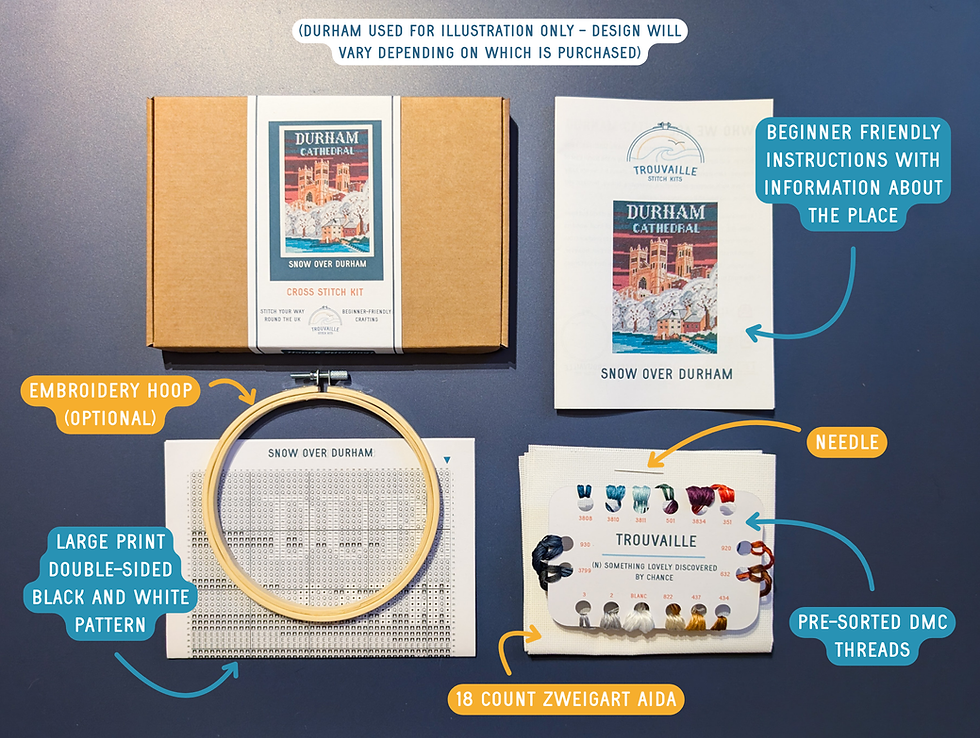
If, however, you're looking to build your own stash, there are a few items that you should consider...
Must Have
Fabric - this should be specially designed cross stitch fabric with an evenly spaced grid of holes (most commonly aida but can be evenweave linen, plastic canvas, perforated card, or anything really that has an even grid of holes). I'd recommend Zweigart fabrics due to their high quality (this is what we include in all our kits.)
Embroidery Thread/Floss - Most projects use 6-stranded embroidery thread which you then split to the number of threads specified by your pattern. While you can get cheap, synthetic threads, you really do get what you pay for and I wouldn't recommend these due to the poor quality and likelihood of colour run when you wash your finished project (the stuff of nightmares!) Most patterns recommend a brand called DMC due to their high quality, 100% cotton threads (this is what we include in all our kits), but another brand or cotton threads you may come across in patterns is Anchor.
Needles - Specific cross stitch needles are available in a variety of sizes. It is important to get a needle that is small enough to fit through the holes in your fabric without stretching the holes.
highly recommend

Embroidery Hoop/Frame - I've not included these in the 'must have' section as some people actually prefer to stitch 'in hand' without them... but I'm not one of them. An embroidery hoop/frame will keep your fabric taught making your project easier to handle and allowing you to produce even stitches.
Embroidery Scissors - A sharp pair of embroidery scissors makes trimming threads super easy and leaves the back of your work super neat.
Pattern - I've not included this in the 'must have' section either as some people like to stitch little designs freehand, but the majority of the time you will be referring to a pattern (this might be paper or digital) to create the design of your choice.
Needleminder - These clever little magnets attach to your project and hold onto your needle when you're not using it, so you don't lose it down the side of the sofa!
extras if needed/wanted

Magnifier -Some patterns require very tiny stitches on fabric with very tiny holes, so a good magnifier can really help, particularly those who have eyesight issues.
Needlethreaders - These nifty little things can make threading your needle a doddle!
Project bag - A good project bag has lots of different spaces for keeping all your tools, materials and patterns safe, tidy and clean, as well as making stitching on the go super easy!
Thread storage - there are lots of beautiful and fancy options for when you're ready to invest a little more, such as the Pip & Chip storage options, but to start, a clear thread box with bobbins works perfectly well!

what stitches are used in cross stitch?
The primary stitch used in cross stitch is, funnily enough, the cross stitch. This is a stitch made up of two diagonal stitches as shown below.

Some people stitch each stitch fully before moving on to the next stitch (known as the English Method), while some stitch all half stitches in a row then work back to finish off the stitches (known as the Danish Method). You can find more about the differences in these methods HERE.
Some patterns will only include cross stitches, such as those in our Artists Collection, however others, such as those in our Landmark Collection, use additional stitches over the top of the cross stitches to add detail. These can include Straight Stitches, Back Stitches and French Knots. As an example, you can see below how we use French knots and straight stitches to create the little ice creams on our Seaside Rendezvous design.

what does a cross stitch pattern look like?

While some people create small designs freehand, the majority of cross stitch projects are completed by following a pattern/chart. Here are a few tips for understanding a cross stitch pattern...
Cross stitch patterns are in the form of a grid which translates to the grid made up by the holes on your fabric, so each square on your pattern represents one cross stitch.
The symbol in each square represents the colour thread needed for that stitch, and a key for the symbols will be provided either in the instructions or on the pattern itself.
The instructions will also outline how many strands of thread you should use for each stitch (this is also sometimes found in the key).
The position of any additional stitches will be shown over the top of the grid of cross stitches. If there is a lot of additional stitches this can make the cross stitch symbols difficult to read, so sometimes two patterns are provided (one with cross stitches only, one with all stitches) as in our Landmark kits.
If a design is large, the printed pattern that you get within a kit might be split into multiple pages.
How to get started with cross stitch
There are a few ways you could get started with cross stitch.
Complete kits - If you've got no/minimal supplies, or want to stitch a design that requires very specific colours, I'd recommend purchasing a beginner-friendly cross stitch kit. We've designed our cross stitch kits to include everything you need to get started all in one box. You will likely have left-over threads too so you can add these to your stash!
Free Patterns - If you've got a few supplies already, maybe you've been gifted them or inherited them from your grandma, and just want to give it a try before you invest much in it, you could try a free pattern. You will find free patterns on a lot of craft websites or cross stitch designer's websites, such as our range of free, beginner-friendly patterns. And if you pick a small pattern with few colours, it's likely that you can just use the colours you have, rather than having to buy more.
Digital Patterns - If you've got lots of supplies already, or are happy to source the supplies needed, you could purchase a digital pattern. Many designers sell PDF patterns of their designs on their websites, with some designs (such as our Sampler collection) only available as digital downloads. You can also find lots available on Etsy but please beware of naff AI generated patterns on platforms such as Etsy!)

I hope you've found this introduction to cross stitch helpful. If you think Cross Stitch sounds a bit of you and you're ready to get going, here are some other blogs you might find useful!
Happy Stitching!
J xx


Comments